
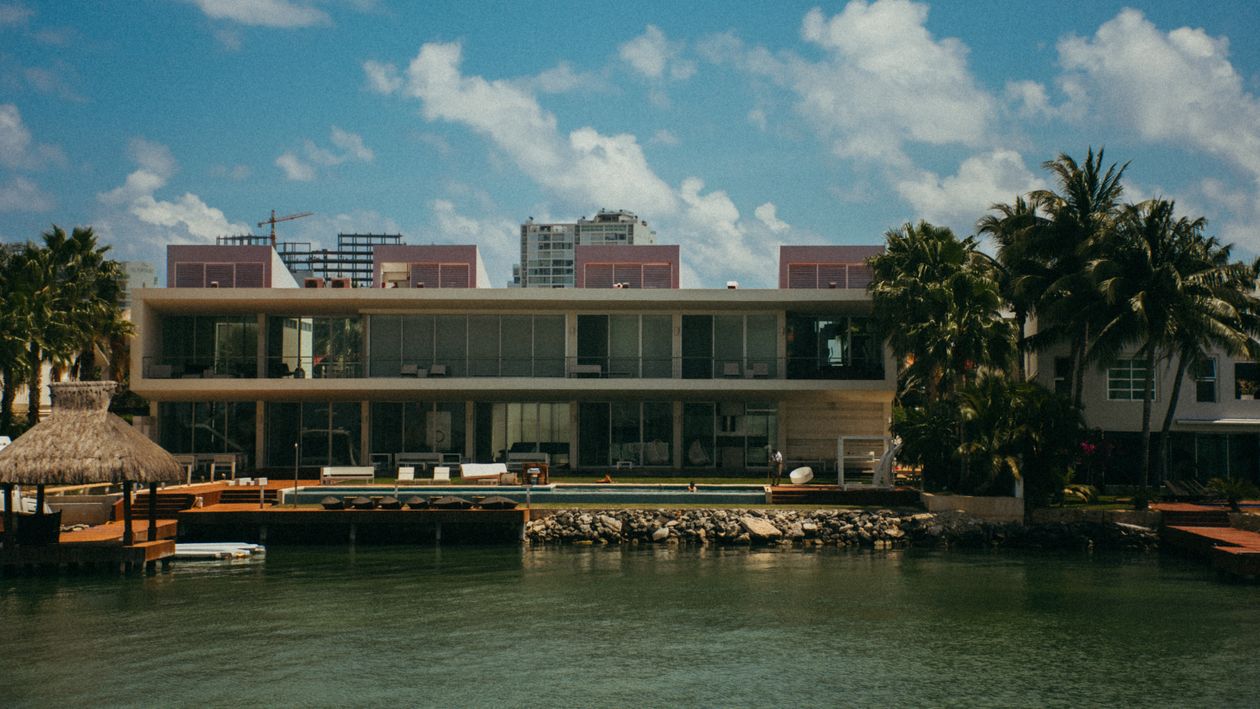
Casa Moderne, a newly built waterfront home at 790 Lake Road in Miami's gated Bay Point enclave, sold for a record $27.25 million in July 2026, a $4,284-per-square-foot canal-front high, according to PROFILEmiami. What I tell LuxuryDade buyers: the record is real but narrow, concentrated in turnkey, new-construction, water-facing product while much of resale cools. Before the price, verify the dockage depth and run the full carrying cost: the annual cost of ownership is what surprises people.
A single sale does not make a market. But a record price per square foot on brand-new waterfront, printed the same week the broader Miami condo market is flashing softness, is a data point worth reading closely. Casa Moderne at 790 Lake Road closed at $27.25 million, which works out to $4,284 per square foot, the highest canal-front per-foot trade Bay Point has ever recorded, per PROFILEmiami. I have spent 2026 telling clients that Miami is a two-speed market. This sale is the top speed, in a single line.
Bay Point is one of the few gated, guard-staffed single-family communities inside the actual City of Miami, tucked north of the Design District and east of Biscayne Boulevard along the bay and its interior canals. Roughly 240 homes sit on winding waterfront streets there. When a home in that kind of scarce, protected pocket sets a per-foot record, it tells you where the deepest-pocketed buyers are still willing to pay up, and where they are not. Let me walk through what the number actually signals.
What a $4,284 Per Square Foot Record Actually Tells You
The headline number is the price: $27.25 million. But the number that matters to anyone reading the market is the per-foot figure. At $4,284 per square foot, Casa Moderne did not just sell high in dollars, it sold high on the one metric that strips out square footage and lets you compare a home to every other home in the neighborhood. That is a record for canal-front Bay Point, per PROFILEmiami, and canal-front is the more common inventory in the enclave than the rarer open-bay lots.
Per-square-foot records on new construction are a specific signal. They tell you buyers at the very top are paying a premium for finished, move-in-ready, current-code product and are not interested in projects, dated homes, or renovation timelines. When the highest per-foot trades are all new builds, it means the trophy buyer is optimizing for certainty and immediacy over land value alone. I see the same behavior in the branded-condo market, where turnkey delivery commands a premium over a shell you have to finish.
My read on the record is straightforward: it is genuine strength, but it is narrow. It confirms the very top of Miami's single-family waterfront market is still setting highs, and it does not tell you the entry-level or mid-market condo tiers are doing the same. Treating one $27 million print as proof the whole market is surging is exactly the mistake I spend most of my time talking clients out of.
"A record price per square foot on new construction is not a signal that the whole market is hot. It is a signal that the very top buyer wants turnkey, waterfront, and current code, and will pay a premium to skip the wait."Gerardo Gonzalez, Licensed Real Estate Agent at Compass
How This Fits Miami's Two-Speed Market
The record lands inside a market that is moving at two different speeds. According to Miami Association of Realtors data, Miami-Dade $1 million-plus single-family home sales rose 26.7 percent year over year in May 2026, part of a ninth straight month of overall sales growth. The high end, especially single-family waterfront, keeps climbing.
At the same time, the condo side is softer, weighed down by post-SB-4D assessment worries, higher insurance, and a wave of new supply. That split is the whole story of 2026 in Miami. Single-family waterfront and branded new-construction are one market; aging condo stock facing reserve catch-ups is another. A Bay Point record does not lift a 1990s condo in a building staring down a special assessment, and buyers need to hold those two pictures in their head at once.
For context on how the two sides diverge, my breakdown of the Miami two-speed market walks through the supply and demand behind the split, and the Miami pre-construction buyer guide covers where new-construction demand is concentrated. The takeaway for a buyer with capital: strength is real but selective, and paying up only makes sense where the scarcity is real, as it is on protected waterfront land.
Why Bay Point Commands the Premium
Scarcity is the whole reason a home in this pocket can print $4,284 per square foot. Bay Point sits behind a single guarded entrance north of the Design District, one of only a handful of gated single-family communities that exist inside the City of Miami proper. Roughly 240 homes, no through traffic, private security, and a waterfront position on Biscayne Bay and its interior canals. You cannot manufacture more of that. When the supply is fixed and the demand is global, price is the only release valve.
The waterfront itself drives the number. Deep-water, no-fixed-bridge dockage that can take a large yacht is genuinely rare in Miami, and it is the feature that separates a good waterfront home from a record one. A canal-front lot with a real dock and quick bay access carries a premium that an interior lot two streets back simply does not, even in the same gated community. This is why the per-foot record was set canal-front, not on a smaller interior parcel.
Location layers on top. Bay Point is minutes from the Design District, Midtown, and Edgewater's new towers, and a short drive from Brickell, which makes it a rare combination of gated privacy and urban proximity. Buyers who want a compound-style waterfront home but refuse to trade away being close to the city core have very few options, and Bay Point is at the top of that short list. For how the surrounding luxury market is priced, see my Coconut Grove luxury developments breakdown for a nearby comparison of waterfront pricing.
The Carrying Cost Behind a Trophy Waterfront Home
Here is the part of a record sale that the headline never covers, and the part I make every buyer confront before we talk price: the annual cost of holding the home. A $27 million waterfront property in Miami does not just cost $27 million. Property taxes alone, before any homestead adjustment, run in the range of 1.8 to 2 percent of assessed value in Miami-Dade, which on a trophy home is several hundred thousand dollars a year.
Insurance is the line that has changed the math most. Windstorm and flood coverage on a low-elevation, water-facing home has climbed sharply, and on a large new-construction estate a full policy can run well into six figures annually. Add dock maintenance, seawall upkeep, a pool, landscaping, and staff, and the true annual carry on a home like this reaches into the mid-six figures before a single mortgage payment. My guidance to buyers on this is blunt: model the carry first, then decide what price you can live with, not the other way around.
This is also where new construction earns part of its premium back. A brand-new home built to current flood-elevation and wind codes insures more favorably and carries no near-term capital-repair risk, unlike an older waterfront home that may need a new seawall, roof, or dock. When you run the numbers over a ten-year hold, the turnkey premium is not purely emotional. It is partly a hedge against exactly the carrying-cost surprises that catch trophy-home buyers off guard.
What This Record Means for You as a Buyer or Owner
A record like this is useful only if you can turn it into a decision. Here is how I frame it for clients depending on where they sit.
If you own waterfront in a gated Miami enclave: Your comp just improved. A fresh per-foot record on new construction resets the ceiling that appraisers and buyers reference. It does not mean an older home earns the same $4,284 per square foot, but it strengthens the case for well-maintained, water-facing product, and it is a reason to get a current valuation rather than lean on a two-year-old number.
If you are shopping for a trophy waterfront home: Chase scarcity, not the sticker. The features that set the record, deep-water dockage, new construction, a protected gated location, are the ones that hold value. Before you fall for a price, run the total carrying cost with the full cost-of-ownership framework and, if you are buying from abroad, my foreign-national buyer guide covers the tax and financing structure you need in place first.
If you are trying to read the wider market: Do not over-index on one print. Pair this record with the softer condo data and you get the honest picture: strength is real at the top of single-family waterfront, thinner elsewhere. The Miami pre-construction buyer guide is the better lens for where new-construction demand actually sits across price tiers.
Frequently Asked Questions

Prefer to talk? Call me at (305) 964-8614 or WhatsApp.