Miami condo developers now fund construction partly with EB-5 visa money: one Surfside tower drew $132 million from 165 investors, per Inman. What I watch at LuxuryDade is the share, not the headline. EB-5 at 13 percent of a capital stack is a supplement, not the thing holding a project up. Ask what percentage of the raise is EB-5 before you wire a deposit.

Most pre-construction buyers study the floor plan, the deposit schedule, and the developer's track record. Almost nobody asks where the construction money is coming from. That question got louder this month: Inman reported on August 6, 2026 that another North Miami Beach condominium project is joining the EB-5 Immigrant Investor Program, formalizing a financing route Miami developers have leaned on for years. If you are weighing a contract, the useful version of this story is not the immigration angle, which my EB-5 investor guide already covers. It is what that capital does to the project you are buying into.
What EB-5 Capital Actually Is Inside a Condo Project
Congress created EB-5 in 1990. A foreign national who invests in a job-creating U.S. commercial enterprise, and whose investment produces at least 10 full-time jobs for qualifying workers, can obtain permanent residence for themselves and their immediate family. The U.S. Citizenship and Immigration Services program makes roughly 9,940 immigrant visas available each year.
Under the EB-5 Reform and Integrity Act of 2022, the standard minimum investment is $1.05 million. It drops to $800,000 for projects inside a Targeted Employment Area, which means a rural area or one the Department of Homeland Security designates as high unemployment, or for an infrastructure project. Large condominium developments frequently qualify.
Here is the part that matters to a buyer. That money does not go into the units. It goes into the developer's capital stack, alongside the construction loan, the sponsor's own equity, and the buyer deposits, as either equity or debt used to finance construction. The EB-5 investor is not buying an apartment. They are funding the building and expecting a green card and their capital back. A separate person, possibly you, buys the apartment.
When a client from Bogota asks me whether EB-5 money in a project is a red flag, my honest answer is that the source of the capital matters far less than the share of it. Every large Miami tower is financed by somebody's outside money. What I want to know is whether one funding channel carries so much of the raise that a policy change on the other side of the world could stall a crane on Biscayne Boulevard.
How Big the EB-5 Slice Really Gets
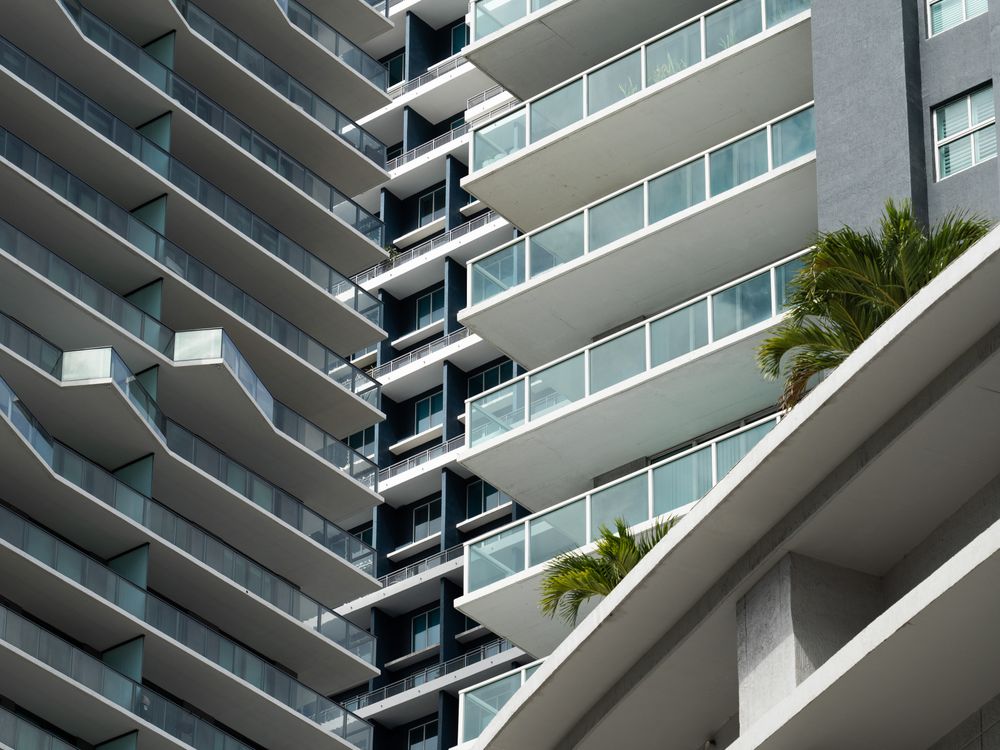
The largest disclosed example in our market gives you the scale. The Four Seasons-branded Surf Club Residences in Surfside, the newer phase built alongside the 2017 hotel and residences, reports EB-5 funds of up to $132 million from 165 investors. The project puts that at roughly 12.8 percent of a $1.035 billion capital stack, a figure Inman cited in its August 2026 report on the trend.
Read that number twice, because it cuts both ways. $132 million is a serious raise, more than most South Florida projects will ever assemble from any single source. It is also one-eighth of the total. Seven-eighths of that tower is financed by conventional construction debt, sponsor equity, and buyer deposits. EB-5 is a real leg of the stool. It is not the stool.
The demand behind it is not speculative either. Foreign buyers accounted for 49 percent of new-construction, pre-construction and condo-conversion sales in South Florida over the 18 months ending July 2025, according to the MIAMI Realtors New Construction Global Sales Report. At the North Miami Beach project Inman profiled, roughly 66 percent of purchasers came from outside the United States, led by Colombia, Argentina, Mexico, Italy, Spain and Turkey. A developer adding EB-5 to a tower selling two-thirds internationally is not reaching for a lifeline. It is selling a second product to a buyer pool already in the room.
The market underneath is holding up too. Miami condo sales rose 11.96 percent year over year in June 2026, to 1,058 closings from 945, and have posted year-over-year gains in eight of the last 10 months, according to the MIAMI Association of Realtors. That is the context I would want before reading anything sinister into a capital-stack line item.
The July 2026 Rule That Could Shrink This Capital Source
In July 2026 the Department of Homeland Security proposed a new rule further implementing the 2022 Reform and Integrity Act. Most of it codifies changes already in force. Two pieces are worth a buyer's attention.
First, price. The rule would raise the minimum investment to $1.4 million for projects in areas DHS designates as High Employment Areas. Statute allows the secretary to set minimums up to three times the standard threshold in those areas, so this is well inside the department's authority. A Brickell or Surfside tower is not a distressed-jobs zone, which is exactly the kind of location that could land in the higher tier. Raise the entry price 33 percent above the standard minimum and the pool of investors willing to write that check gets smaller.
Second, enforcement. The proposal gives USCIS an explicit framework for responding to fraud, abuse, criminal misuse, or threats to public safety it uncovers: deny petitions, revoke approved ones, terminate conditional permanent residence, shut down regional centers, and permanently debar participants. That is good for program integrity and it is one more reason a project's EB-5 tranche should be a slice rather than a load-bearing wall.
None of this is final. A proposed rule is a proposal, and the comment process can change it. But if you are signing a contract on a tower that delivers in 2028 or 2029, the financing environment three years from now is a fair thing to ask about today. My step-by-step pre-construction buying process covers where in the timeline you still have leverage to ask.
Here is how EB-5 money compares to the other capital sitting in the same project:
| Factor | EB-5 Capital | Construction Loan | Your Deposit |
|---|---|---|---|
| Who puts it in | Foreign investors seeking residence | A bank or private lender | You, the unit buyer |
| What they get back | Green card path plus return of capital | Interest and principal | An apartment at closing |
| Typical share of the stack | Roughly 13 percent on the largest disclosed local example | Usually the largest single piece | Staged, commonly 20 to 50 percent by delivery |
| What can interrupt it | Visa policy, minimum-investment changes, processing backlogs | Rates, appraisals, lender credit policy | Sales pace at the project |
| Where you sit if it stalls | Indirect: a funding gap the sponsor must replace | Indirect: same, usually more disruptive | Direct: your contract and escrow terms govern |
That last row is the one to internalize. Your money and the EB-5 investor's money are not in the same position and are not governed by the same documents. Your protection is the purchase contract and Florida's escrow rules, not the sponsor's fundraising plan. What EB-5 concentration changes is the odds that the building actually gets finished on schedule, which is a different risk with a different remedy.
What to Ask Before You Wire a Deposit
There is a second reason developers are courting this capital now, and it is the same reason buyers are nervous. Post-Surfside reforms pushed Miami-Dade condominium carrying costs up hard. Florida International University's Jorge M. Perez Metropolitan Center estimates median condo association fees in Miami-Dade have climbed more than 70 percent since 2016. Older buildings absorbed that shock; new construction is being sold as the way around it. Whether that holds depends on whether the reserve budget was written honestly, which my building financial health guide walks through line by line.
So when a sales gallery brings up EB-5, treat it as an opening rather than a warning. These are the questions I put to a sales team on a client's behalf:
- What percentage of the total capital stack is EB-5? A number under about 15 percent reads as a supplement. A number well north of that deserves a follow-up about the backup plan.
- Is the EB-5 tranche committed or still being raised? Committed capital and a marketing pitch are not the same thing, and only one of them is on the balance sheet.
- Does the project sit in a Targeted Employment Area? The answer determines whether the $800,000 or $1.05 million minimum applies, and how exposed the raise is to a High Employment Area redesignation.
- Who is the construction lender, and is the loan closed? A closed senior loan tells you more about delivery odds than any equity story.
- What happens to my deposit if the project does not break ground? Ask for the escrow language in writing, not a verbal summary.
- What is the projected association budget at delivery? Given the 70 percent fee climb since 2016, an optimistic first-year budget is a bigger threat to your returns than the sponsor's funding mix.
If you are buying from outside the United States, the ownership structure sitting behind those answers matters just as much as the answers themselves. My foreign national buyer guide covers the entity, financing, and withholding side, and the SB-4D special assessment guide covers what the reserve rules do to a building's cost base after delivery.
"The thing I tell pre-construction buyers about EB-5 is that it is a financing fact, not a quality signal, in either direction. A tower is not better because immigrant capital believes in it and it is not worse because it needed the money. Ask for the percentage. A slice is normal. A load-bearing wall is a question."Gerardo Gonzalez, Licensed Real Estate Agent at Compass
Frequently Asked Questions: EB-5 Capital and Miami Condo Projects

Prefer to talk? Call me at (305) 964-8614 or WhatsApp.