Foreign buyers purchased $4.4 billion of South Florida homes in 2025, up 42 percent, per the Miami Association of Realtors, while NAR's 2026 report shows US foreign purchases falling 19.1 percent to $45.3 billion. Gerardo Gonzalez of LuxuryDade, a licensed Compass agent who works these deals in Spanish and Portuguese, reads that gap as Latin American capital choosing Miami over the rest of the country. Check each report's survey window below before comparing figures.

Foreign capital is the engine under Miami's luxury market, and in 2026 that engine is running hotter than it has in years. According to the Miami Association of Realtors 2025 International Report, foreign buyers purchased $4.4 billion of South Florida residential real estate, up from $3.1 billion the year before, a 42 percent jump and the largest foreign-buyer total of any US market. Global buyers closed 5,300 South Florida properties, up from 4,000. The foreign-buyer share of dollar volume hit 15 percent, roughly seven times the US figure of about 2 percent and three times Florida's 5 percent.
Two forces drove the surge, and both are the kind I watch closely: a weaker US dollar against several major currencies, and continued political instability, particularly in Latin America, that pushes high-net-worth families to park money in a stable market. Miami is at the top of their list because it is the most diverse major US city and because it has one of the nation's deepest new-construction condo pipelines, exactly the product global buyers want. This report walks through where the money comes from, how it pays, what it buys, and how I read a foreign buyer's country of origin before I ever read the listing.
- The 2026 Headline: $4.4 Billion in Foreign Capital
- Source Check, September 2026: Four Reports, Four Windows
- Where the Money Comes From: Top Countries
- Why They Buy: Weak Dollar and Safe-Haven Flight
- How They Pay: 51 Percent All-Cash
- New Construction: 49 Percent Foreign
- What They Spend: A $558,700 Median
- Where They Land: County and Submarket Map
- Outlook: Where the Flows Go from Here
- Gerardo's Read by Country of Origin
- How This Report Is Built
- Frequently Asked Questions
The 2026 Headline: $4.4 Billion in Foreign Capital
The defining fact of Miami's international market in 2026 is scale. Per the Miami Association of Realtors 2025 International Report, foreign buyers purchased $4.4 billion of South Florida residential real estate, up from $3.1 billion the prior year. That is a 42 percent jump in a single year and the largest foreign-buyer total of any US market. Global buyers closed 5,300 South Florida properties, up from 4,000, meaning both the dollars and the transaction count rose together, not one at the expense of the other.
The share number is even more telling than the total. South Florida's foreign-buyer share, measured as foreign purchases as a percentage of dollar volume, reached 15 percent in 2025. That is roughly seven times the US figure of about 2 percent and more than three times Florida's 5 percent. No other US metro comes close to that concentration of international capital. When one in every seven dollars of residential volume comes from overseas, foreign flows are not a side story in Miami luxury, they are the main story.
This also puts Miami's national standing in context. In NAR's 2026 International Transactions in U.S. Residential Real Estate report, which covers April 2025 through March 2026, Florida stayed the top US destination at 20 percent of foreign buyers, narrowly ahead of California at 19 percent. Within the state, 45 percent of international buyers purchased in the Miami-Fort Lauderdale-West Palm Beach metro between August 2024 and July 2025, per the Florida Realtors 2025 Profile of International Residential Transactions, and the Miami Association of Realtors estimates South Florida secures roughly 10 percent of every international home sale in the country. That is the base rate every figure in this report sits on top of.
Forty-two percent growth in foreign dollar volume in one year is not a normal real-estate number, it is a capital-flight number. From my desk, when the dollar weakens and a Latin American election cycle turns, my phone starts ringing before the data ever prints.
Gerardo Gonzalez, Licensed Real Estate Agent at Compass
Source Check, September 2026: Four Reports, Four Different Windows
Every foreign-buyer figure on this page comes from one of four published reports, and no two of them measure the same months or the same geography. That matters because a headline like "foreign buying fell" and a headline like "foreign buying surged" can both be true at once. On September 14, 2026 I re-checked each figure below against its publisher's own release. The table states what each report covers so a reader can see which numbers can be compared directly and which cannot.
| Report and publisher | Released | Transactions covered | Geography | Headline figures used here |
|---|---|---|---|---|
| 2025 Profile of International Home Buyers, Miami Association of Realtors | January 27, 2026 | Member survey of international transactions; the release dates the survey August 2025 to October 2025 | Miami-Dade, Broward and Palm Beach | $4.4 billion; 5,300 properties; 15% of dollar volume; 51% all cash |
| New Construction Global Sales Report, Miami Association of Realtors (named in the January 2026 release) | July 2025, follow-up November 2025 | New construction, pre-construction and condo-conversion sales, 18 months ending July 2025 | South Florida | 49% bought by international buyers; buyers from 73 countries in the November edition |
| 2025 Profile of International Residential Transactions in Florida, Florida Realtors | November 11, 2025 | August 2024 to July 2025 | Florida | $10.4 billion; 16,400 homes; 45% in the Miami metro; 60% all cash; $442,000 median |
| 2026 International Transactions in U.S. Residential Real Estate, National Association of Realtors | July 29, 2026 | April 2025 to March 2026 | United States | $45.3 billion; 67,100 homes; Florida 20% of foreign buyers; 48% all cash; $465,000 median |
The newest of the four is NAR's July 2026 report, and it moved the national baseline down on almost every measure. The comparison below uses only NAR's own two editions, so the windows line up.
| Measure | 2025 edition (prior 12 months) | 2026 edition (April 2025 to March 2026) |
|---|---|---|
| Dollar volume | $56 billion | $45.3 billion (down 19.1%) |
| Homes purchased | 78,100 | 67,100 (down 14%) |
| Median purchase price | $494,400 | $465,000 |
| All-cash share | 47% | 48% |
| Florida share of foreign buyers | 21% | 20%, narrowly ahead of California at 19% |
Sources: 2026 figures and the 2025 dollar volume and home count from the NAR July 29, 2026 release; the 2025 edition's median, all-cash share and Florida share as quoted by the Miami Association of Realtors and Florida Realtors. NAR's chief economist tied the national decline to fewer international visitors to the US.
Here is how I read the split. The national count fell 14 percent while South Florida's count rose from 4,000 to 5,300, and both reports describe activity during 2025, so the gap is hard to explain as a calendar artifact alone. My working view is that the buyers who stopped coming were largely tourist-driven and second-home buyers elsewhere in the country, while Latin American families moving capital out of currency risk kept choosing Miami. What I would not do is quote the 42 percent and the minus 19.1 percent side by side as if they measured the same thing: one is a local member survey, the other a national one, and the South Florida edition covering 2026 has not been published yet.
The statewide numbers also correct a common assumption. Canada is Florida's top international buyer at 18 percent in the Florida Realtors profile, yet only 5 percent of South Florida's foreign buyers in the Miami Association of Realtors report, which implies most Canadian buyers purchase elsewhere in the state. If you are a Canadian buyer weighing Miami, my guide for Canadian buyers in Miami covers the cross-border tax steps, and my guide for Argentine buyers covers the cohort that ranks second here. For the supply these buyers are shopping, see the South Florida condo pipeline stage report, the Miami condo delivery calendar and the branded residences pipeline; for the local sales series the association publishes monthly, see the South Florida housing market data tracker.
Next update: I will re-check all four sources and revise this page by November 30, 2026, or sooner if any publisher releases a new edition. Florida Realtors released its last profile on November 11, 2025, so its 2026 profile is the next report due.
South Florida's foreign demand is Latin American first, and diversified far beyond it. Per the Miami Association of Realtors, Colombia is the top foreign country buying South Florida real estate at 15 percent of foreign-buyer share, followed by Argentina at 12 percent, then Mexico and Brazil tied at 7 percent each. Colombia and Argentina together account for 27 percent of all South Florida international closed sales. The full roster spans 55 countries, a diversity no other US metro matches.
That diversity is a structural advantage, not a footnote. Most US markets draw from two or three foreign countries, so when one currency or economy turns, their international demand evaporates. Miami's 55-country base means that when Argentine demand cools, Mexican or European demand steps up to fill the gap. It is the reason Miami's foreign volume stays high through cycles that flatten other cities, and it is why I never treat "foreign buyer" as one profile.
| Country | South Florida Foreign Share | Miami-Dade Rank | Median Purchase Price |
|---|---|---|---|
| Colombia | 15% | #1 (18% of Miami-Dade) | $583,000 |
| Argentina | 12% | #2 (13% of Miami-Dade) | $458,100 |
| Mexico | 7% | #4 (6% of Miami-Dade) | $934,000 |
| Brazil | 7% | #3 (9% of Miami-Dade) | $777,400 |
| Venezuela | 5% | tied #4 (6% of Miami-Dade) | $450,000 |
| Canada | 5% | top 6 | $500,000 |
Two patterns stand out in this table. First, the countries with the most buyers are not the ones spending the most per unit: Mexican and Brazilian buyers post the highest median prices ($934,000 and $777,400) even though Colombia and Argentina send more buyers. Second, the county-level picture is even more concentrated than the region: in Miami-Dade specifically, Colombia leads at 18 percent and Argentina at 13 percent, so downtown and Brickell inventory skews more heavily toward those two flags than the regional averages suggest.
Why They Buy: A Weak Dollar and Safe-Haven Flight
The 42 percent jump in foreign volume did not happen by accident, and the Miami Association of Realtors names both drivers directly. The first is currency: the US dollar slid against several major currencies in 2025, and a weaker dollar means more savings for a high-net-worth overseas buyer converting into a Miami purchase. The euro was one of the strongest winners against the dollar last year, which is a direct reason European share of Miami demand has grown across this cycle.
The second driver is safe-haven flight. Political instability, especially in Latin America, pushes global buyers to look for stable places to park capital, and Miami is at the top of that list. The motive shows up in the buyers' own stated reasons: about 93 percent of Miami global buyers purchased for security, profitability, or location. Broken down, 35 percent bought for a secure investment, 33 percent for a desirable location, and 25 percent for a profitable investment. When someone is moving money out of currency and country risk, a hard asset in a US jurisdiction is the goal, and the specific unit is almost secondary.
These two forces feed a behavior that surprises domestic agents: many foreign buyers close with almost no in-person visits. Per the same report, about 11 percent of South Florida foreign buyers purchased without ever visiting Florida, 25 percent bought after a single visit, and 65 percent purchased with two visits or fewer. From my desk that means the whole transaction runs on trust, video walkthroughs, and a licensed agent the buyer can reach at 9 p.m. their time. It is a different sales motion than a local move-up buyer, and it rewards the agent who can close remotely and structure cleanly.
How They Pay: 51 Percent All-Cash
Cash dominance is the structural feature that separates Miami's foreign cohort from almost every other market. About 51 percent of all international residential transactions in South Florida were all-cash in 2025, per the Miami Association of Realtors, above the 48 percent all-cash share NAR measured for all US foreign buyers between April 2025 and March 2026. Statewide the cash habit is stronger still: 60 percent of Florida's international buyers paid all cash between August 2024 and July 2025, per Florida Realtors. Inside the luxury and ultra-luxury condo tiers that cash share runs even higher, because the buyer pool is dominated by principals and family offices who already hold the equity offshore and want it out of currency risk fast.
The practical effect at the negotiating table is real, and it is the single biggest reason foreign demand is resilient to US interest-rate moves. Cash buyers compress closings from the standard 45-to-60-day financed timeline to two to four weeks, drop appraisal and lender contingencies, and earn negotiating room on price and on HOA-reserve assumptions with sellers facing Florida SB 4-D pressure. When a strong unit lists on a Friday, an all-cash Argentine or Venezuelan principal can be under contract before a financed local buyer has finished loan paperwork. I have watched that speed win contested units at a lower net price than a higher financed offer.
Not every foreign buyer goes fully cash, and the split is often about tax planning, not means. European principals more often use a US LLC plus a DSCR (debt service coverage ratio) loan, writing 30 to 40 percent down through US-licensed lenders rather than paying all cash, because the entity and the debt change their FIRPTA and estate exposure. Federal Reserve rate posture barely moves the all-cash majority, but a late-2026 rate cut would unlock the financed minority. For the financing playbook foreign buyers actually use, see my DSCR loan guide for foreign buyers.
New Construction: 49 Percent Foreign
Foreign demand is the load-bearing wall under Miami's pre-construction market specifically. International buyers purchased 49 percent of new construction, pre-construction, and condo-conversion sales in South Florida over the 18 months ending July 2025, per the Miami Association of Realtors first New Construction Global Sales Report. A follow-up November 2025 report showed global buyers from 73 countries. Nearly half of every new unit sold going to an overseas buyer is why Miami's pre-construction towers pre-sell so heavily before a foundation is poured.
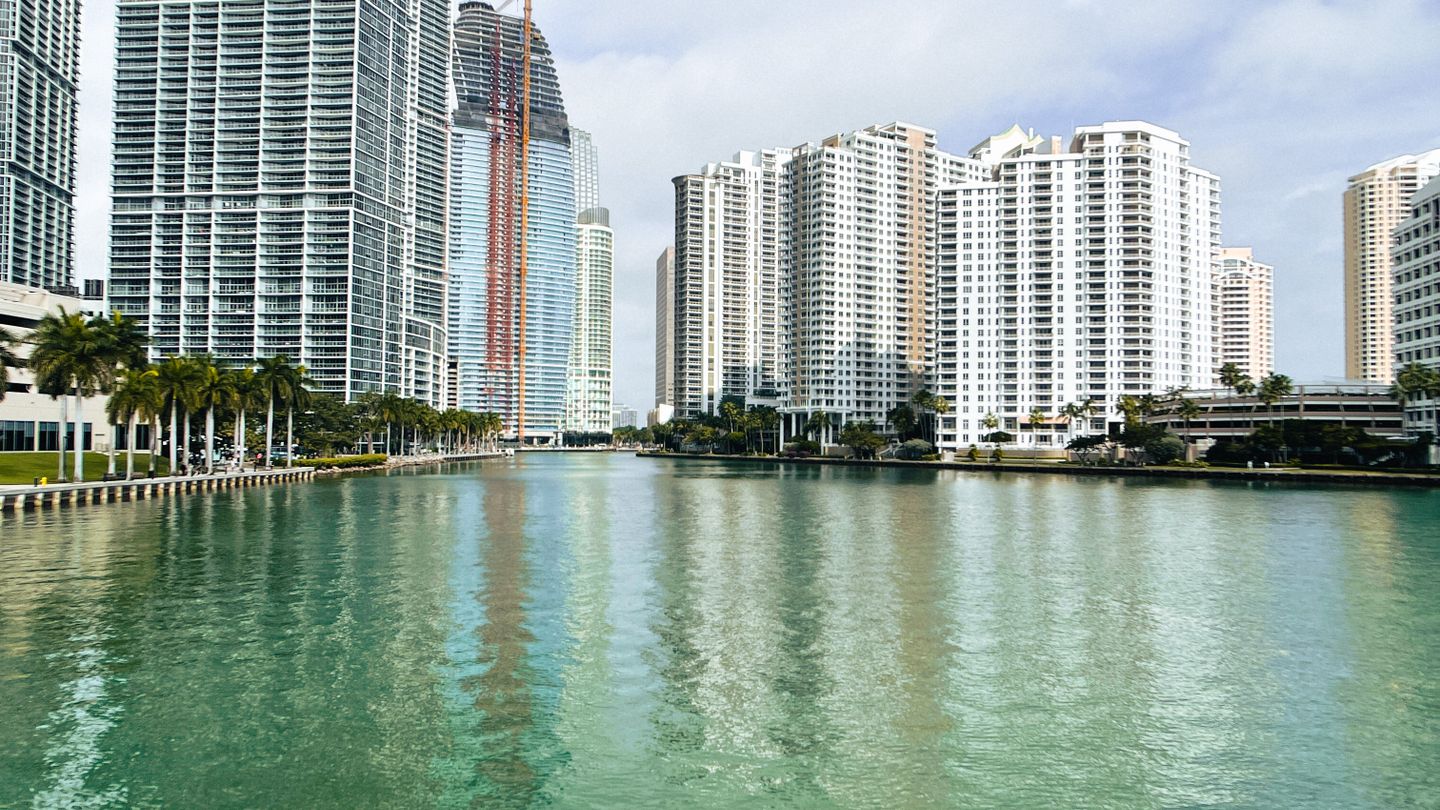
The composition shifts by submarket. Brickell branded pre-construction (Cipriani, St. Regis, Waldorf Astoria, Mandarin Oriental Brickell Key) skews heavily international, led by Colombia, Argentina, Brazil, Mexico, and Venezuela, with growing share from Italy, Germany, Switzerland, and the UK. Oceanfront Surfside, Bal Harbour, and Sunny Isles draw more domestic relocators from New York, California, and Chicago alongside their international cohort. Edgewater and Coconut Grove sit in between, pulling regional move-up buyers and first-time international purchasers.
The reason foreign buyers love pre-construction is the deposit structure, not just the finish. A Miami pre-construction contract typically staggers deposits (often 10 percent at contract, 10 percent at groundbreaking, more at milestones) over the two-to-four-year build, which lets an overseas buyer move capital out of their home currency in tranches rather than all at once. That schedule is a currency-hedging tool as much as a payment plan. For how those deposits are structured, see the Miami pre-construction deposit schedule. A buyer who also wants a green card should keep that purchase separate from an EB-5 filing; the USCIS minimums, fees and the January 1, 2027 inflation date are in my EB-5 guide, checked against USCIS.
- Foreign share of new construction: 49 percent (18 months ending July 2025)
- Countries represented in new construction: 73 (Nov 2025 report)
- Leading source regions: Latin America first, then Europe (Italy, Germany, Switzerland, UK)
- Most international submarket: Brickell branded pre-construction
- Cash skew: Latin American principals near all-cash; European principals more LLC-plus-loan
What They Spend: A $558,700 Median, Far Above the US
Foreign buyers spend more than domestic buyers, and Miami's foreign buyers spend more than foreign buyers elsewhere in the US. Miami international home buyers paid a median price of $558,700 in 2025, about 13 percent above the $494,400 US foreign-buyer median it was compared with, per the Miami Association of Realtors. That national benchmark has since moved down: NAR's 2026 edition puts the US foreign-buyer median at $465,000, and Florida Realtors put the statewide international median at $442,000. The spread by country is wide, and it does not track the volume ranking, which is one of the most useful things to know before you read a competing offer.
| Country | Median Purchase Price | Typical Payment | Primary Submarkets |
|---|---|---|---|
| Mexico | $934,000 | Often all-cash | Brickell, Sunny Isles |
| Brazil | $777,400 | Cash and LLC-plus-loan | Brickell, Bal Harbour |
| Colombia | $583,000 | Cash-heavy | Brickell, Edgewater, Doral |
| Canada | $500,000 | Mixed | Hollywood, Sunny Isles |
| Argentina | $458,100 | Near all-cash | Brickell, Sunny Isles |
| Venezuela | $450,000 | Near all-cash | Doral, Brickell |
Two patterns are worth acting on. First, Mexican and Brazilian buyers set the highest medians ($934,000 and $777,400) even though Colombia and Argentina send more buyers, so a Mexican or Brazilian offer on a trophy unit is often the one to beat on price. What a buyer from Mexico needs settled before that offer goes in is in my Mexican buyers guide. Second, South Florida foreign buyers overwhelmingly prefer condominiums at 51 percent, far above the 15 percent US average, and cluster in central and urban areas at 63 percent, with 71 percent intending vacation or rental use. That is exactly why Brickell and the urban core carry the deepest international demand.
Where They Land: County and Submarket Map
Foreign capital does not spread evenly across South Florida, and the county split is stark. Miami-Dade County carries 73 percent of South Florida's foreign-buyer volume, totaling $3.2 billion in 2025, per the Miami Association of Realtors. Broward accounted for $785 million and Palm Beach $123 million. So when people say "Miami foreign buyer," they overwhelmingly mean Miami-Dade, and inside it Brickell, the urban core, Sunny Isles, and Bal Harbour.
The country leaderboard also shifts by county, which is a detail I use constantly. In Miami-Dade, Colombia leads at 18 percent and Argentina follows at 13 percent, with Brazil third at 9 percent. In Broward, Colombia leads at 22 percent, Argentina at 15 percent, and Canada climbs to third at 10 percent, a Canadian tilt you do not see in Miami-Dade. In Palm Beach, Argentina dominates at 34 percent, more than double any other flag. Read the county before you read the buyer, because a Canadian offer is far more likely in Fort Lauderdale than in Brickell.
| County | Foreign Volume 2025 | Share of South FL | Top Country |
|---|---|---|---|
| Miami-Dade | $3.2 billion | 73% | Colombia (18%) |
| Broward | $785 million | ~18% | Colombia (22%) |
| Palm Beach | $123 million | ~3% | Argentina (34%) |
The out-of-state story runs alongside the foreign one and reinforces the same submarkets. New York was the top US state buying in South Florida for the sixth consecutive year at 24 percent of out-of-state buyers, followed by California at 14 percent and New Jersey at 9 percent, per the Miami Association of Realtors. New York, California, and New Jersey together made up 47 percent of out-of-state buyers. Domestic relocators and foreign principals compete for the same trophy oceanfront and Brickell inventory, which is why those pockets clear fastest.
The FIFA World Cup Demand Window
One near-term catalyst is worth flagging for the second half of 2026. The FIFA World Cup at Hard Rock Stadium in June and July compresses a year of international buyer attention into a roughly 90-day window. Tournament-period inquiries typically convert to closings six to twelve months later, so the contracts written in summer 2026 will show up in the closing data through the first half of 2027. Foreign buyers planning a Miami purchase should expect heightened competition for Brickell and oceanfront inventory during and just after the tournament.
FIRPTA: The Tax Decision Every Foreign Buyer Must Make First
For foreign buyers, the tax structure decided at purchase matters more than almost any other line item. FIRPTA (the Foreign Investment in Real Property Tax Act) does not trigger at purchase, it triggers at resale, when the buyer or escrow agent must withhold 15 percent of the gross sales price and remit it to the IRS unless a withholding certificate reduces it. On a $5 million unit that is $750,000 parked at the IRS until the seller files a US return. The thing I tell every international client is the same: engage a US tax advisor and decide your entity structure before you sign, never at closing. My full walkthrough is in the FIRPTA withholding guide.
Outlook: Where the Flows Go from Here
The data supports continued strength in foreign demand through the rest of 2026. The two structural drivers, a soft dollar and Latin American capital flight, remain intact, and the 55-country diversity means Miami is insulated from any single economy turning. My read is that foreign volume holds near or above the 2025 pace, with the Colombian and Argentine flags staying dominant, Mexican and Brazilian buyers continuing to set the highest medians, and European share growing on euro strength. The all-cash majority keeps foreign demand largely immune to US rate moves.
The newest national data is the caution on that view. NAR's 2026 report, published July 29, 2026, shows US foreign purchases down 19.1 percent in dollars and 14 percent in homes for April 2025 through March 2026, and Florida's share of foreign buyers slipped from 21 to 20 percent. South Florida's own figures for 2026 have not been published yet. Until they are, I treat the $4.4 billion as the ceiling of the last cycle, not a floor, and I would want to see the Miami Association of Realtors' next international report before calling the local surge durable.
Three forces matter most for the second half. First, the FIFA World Cup window concentrates international attention into summer, with contracts converting to closings into early 2027. Second, Federal Reserve rate posture barely moves the cash-heavy foreign cohort, but a late-2026 cut would unlock the financed minority (largely European LLC-plus-loan buyers) and broaden demand. Third, Florida insurance and SB 4-D reserve pressure will keep separating well-run newer towers from older buildings, and foreign buyers, who skew toward new construction, are on the right side of that split.
- Foreign volume: Strong local drivers, but the national count fell 14 percent in NAR's 2026 report, so treat the 2025 $4.4 billion as a high-water mark until the next local report
- Colombia and Argentina: Stay the dominant flags, 27 percent of closed sales combined
- Mexico and Brazil: Continue to set the highest median purchase prices
- European share: Growing on euro strength; more LLC-plus-loan structures
- All-cash share: Stays near 51 percent regardless of the Fed path
Gerardo's Read by Country of Origin
The single most useful thing I do with a foreign buyer is read their country of origin before I read a listing, because the negotiating style, the payment method, and the target submarket all shift by flag. Below is how I steer the three cohorts I see most often, drawn from working these deals directly. For the building-by-building branded comparison international buyers ask about most, see my St. Regis vs. Cipriani vs. Waldorf comparison.
Colombian and Argentine Buyers (Brickell and the urban core)
Colombia and Argentina lead the foreign leaderboard, together at 27 percent of South Florida closed sales, and they behave similarly at the table: near all-cash, capital-preservation motive, decisive when the right unit appears. I steer this cohort toward branded Brickell pre-construction: Cipriani Residences Brickell, St. Regis Residences Brickell, and Waldorf Astoria Residences. The deposit schedule lets them move pesos out of currency risk in tranches, and the top global brand defends resale value better than unbranded stock.
Mexican and Brazilian Buyers (highest budgets, trophy product)
Mexican and Brazilian buyers post the highest median prices of any Miami foreign cohort ($934,000 and $777,400), so this is the group I place in true trophy product: oceanfront Sunny Isles, Bal Harbour, and the top branded Brickell lines. Brazilian buyers more often mix cash with an LLC-plus-loan structure, so I get their entity and FIRPTA framework set early, and the reais-side timing and paperwork sit in my guide for Brazilian buyers in Miami. See my foreign-national buyer guide for the structuring path a high-budget cross-border buyer needs before signing.
European Buyers (euro strength, LLC-plus-loan)
The European share, led by Italy, Germany, Switzerland, and the UK, has grown on euro strength, and these buyers behave differently: more likely to finance through a US LLC plus a DSCR loan for tax reasons rather than pay all cash. I place them in Brickell branded pre-construction and Miami Beach established luxury, and I bring their US tax advisor into the deal before the contract, not at closing. The financing playbook is in my DSCR loan guide for foreign buyers, and the new-supply pipeline they shop is in the new-construction condo report.
In Miami luxury, the worst decision is buying a beautiful unit inside a building with a balance-sheet problem. Reserves, sponsor track record, and SB 4-D status get me to yes or no faster than a view or a finish ever will.
Gerardo Gonzalez, Licensed Real Estate Agent at Compass
How This Report Is Built
What it is. A compilation of published foreign-buyer statistics for South Florida, set against the Florida and US figures that give them context. LuxuryDade does not run its own buyer survey, and nothing on this page is drawn from MLS listing data. Every number is taken from one of the four reports in the source check table and attributed to it where it appears.
How to check any figure. Find the publisher named next to the number, then open that publisher's release from the table. Where a comparison mixes two publishers, the sentence says so. Country shares are shares of foreign buyers, not of dollars, unless the text says dollar volume.
Known limits. All four sources are surveys of Realtor association members, extrapolated to a market total, so they describe transactions a member handled and may miss deals closed without one. Their windows do not match: Florida Realtors runs August to July, NAR runs April to March, and the Miami Association of Realtors labels its figures by year. The country median prices come from the Miami Association of Realtors, but the "Typical Payment" and "Primary Submarkets" columns and the submarket notes are Gerardo Gonzalez's professional read, not survey output, and are written in the first person wherever they appear in the text. The pre-construction share (49 percent) covers a different, 18-month window from every other figure here.
Last verified September 14, 2026, against all four publisher releases. Next scheduled update by November 30, 2026, or on the release of a new edition of any source.
Related Resources
- Q1 2026 Miami Pre-Construction Market Report
- which South Florida counties actually gained income from people moving in
- Buyer's Guide to Miami Pre-Construction 2026
- St. Regis vs. Cipriani vs. Waldorf Astoria: Miami Comparison
- Foreign National Buyer Guide: FIRPTA, LLC, DSCR
- True Cost of Owning a Miami Luxury Condo 2026
- Florida SB 4-D Condo Reserves and Capital Calls
Key Takeaways
- Foreign buyers purchased $4.4 billion of South Florida residential real estate in 2025, up 42 percent from $3.1 billion and the largest foreign total of any US market, per the Miami Association of Realtors.
- The South Florida foreign-buyer share hit 15 percent of dollar volume, roughly seven times the US figure of about 2 percent and three times Florida's 5 percent, per the same 2025 International Report.
- Colombia leads at 15 percent and Argentina at 12 percent of foreign-buyer share, with Colombia and Argentina together at 27 percent of all South Florida international closed sales, per Miami Association of Realtors data.
- About 51 percent of foreign transactions were all-cash and international buyers took 49 percent of new construction, with a median foreign purchase price of $558,700, per the Miami Association of Realtors.
- Florida stayed the top US destination for foreign buyers at 20 percent in NAR's 2026 report, down from 21 percent a year earlier, while US foreign purchases fell 19.1 percent to $45.3 billion, per NAR.
Quick Facts: Miami Foreign Buyer Flow 2026
| South Florida foreign volume, 2025 | $4.4 billion (up from $3.1B) |
| Year-over-year volume growth | +42% |
| Foreign share of dollar volume | 15% (US ~2%, Florida 5%) |
| Foreign properties closed, 2025 | 5,300 (up from 4,000) |
| All-cash share of foreign transactions | 51% (US foreign buyers 48%, NAR 2026) |
| Foreign share of new construction | 49% (18 mo. ending July 2025) |
| Median foreign purchase price | $558,700 (US foreign buyers $465,000, NAR 2026) |
| Florida share of all US foreign buyers | 20% (NAR 2026, April 2025 to March 2026) |
| Florida international buyers in the Miami metro | 45% (Florida Realtors, August 2024 to July 2025) |
| Top country of origin | Colombia (15%), then Argentina (12%) |
Frequently Asked Questions