As of September 2026, the South Florida housing market is split. According to the Redfin Data Center, the broad Miami-Dade median sale price sits at $568,727 (+1.6% year over year), with 8.7 months of supply and a 90-day median time on market. At the same time the Miami luxury tier median reached $4,957,251 for the three months ending August 2026, up +18.4% year over year. This is LuxuryDade's live South Florida market tracker, so you see the trend, not just one month.
South Florida market scoreboard
Our latest South Florida read, current to September 2026.
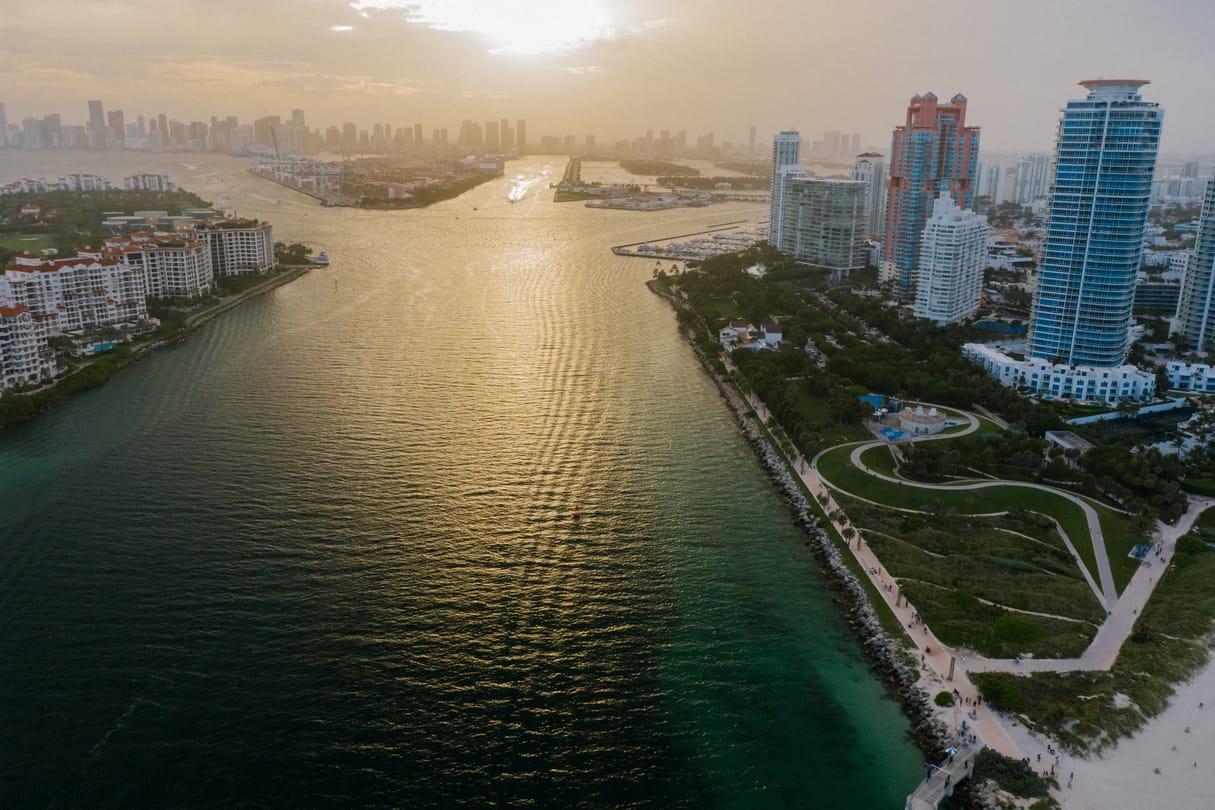
South Florida median sale prices were flat to slightly down in September 2026 while the luxury tier climbed.
This is my live South Florida market tracker, not a one-time snapshot. I compile it for the three counties I work in every day, Miami-Dade, Broward, and Palm Beach, and I refresh it each month so the trend lines stay current rather than going stale. You will not find this exact read packaged anywhere else, it is the same market picture I walk my own clients through before they buy or sell.
One note on what this is and what it is not. These are aggregated market figures, not MLS or proprietary brokerage data, and any month with no reported value shows as "unavailable" rather than a guessed number. If you want a building-specific or unit-specific read on top of this market context, that is the conversation to have with me directly.
Explore the data: pick a metric and time range
Use the controls to switch the metric and time range. The chart and its caption update in place, no page reload.
Median sale price by county, last five years.
The Luxury Tier Is Pulling Away From the Broad Market
The single clearest story in the South Florida data right now is the gap between the broad market and the luxury tier. I track a separate luxury series, the top price bucket, on a rolling three-month basis. In the Miami metro, per the Redfin Data Center, that luxury median reached $4,957,251, up +18.4% from $4,186,801 in the three months ending August 2025. Over the same window the broad Miami-Dade median was +1.6% year over year. When the top of the market rises double digits while the middle is flat to down, that is a flight to quality, and it is exactly what I see in the branded and waterfront product I track.
Key takeaway: the Miami luxury-tier median rose from $4,186,801 in the three months ending August 2025 to $4,957,251 in the three months ending August 2026, +18.4% year over year.
| Month | Miami | West Palm Beach |
|---|---|---|
| 2026-03 | $4,833,410 | $4,305,073 |
| 2026-04 | $4,893,127 | $4,275,100 |
| 2026-05 | $4,832,885 | $4,281,162 |
| 2026-06 | $4,868,048 | $4,374,693 |
| 2026-07 | $4,927,031 | $4,495,506 |
| 2026-08 | $4,957,251 | $4,575,395 |
The luxury tier also moves slowly. The Miami luxury median time on market was 165 days, far longer than the broad market, because trophy and high-end inventory trades on a longer arc with fewer buyers in the queue at any moment. That is normal at the top of the market and is not a sign of weakness on its own.
| Month | Miami | West Palm Beach |
|---|---|---|
| 2026-03 | 145 | 101 |
| 2026-04 | 150 | 102 |
| 2026-05 | 157 | 99 |
| 2026-06 | 174 | 99 |
| 2026-07 | 172 | 100 |
| 2026-08 | 165 | 104 |
County Median Prices and the Year-Over-Year Picture
Across the broad market, the three counties are clustered but not identical. As of September 2026, the Miami-Dade median sale price was $568,727 (+1.6% year over year), Broward was $453,984 (+0.9%), and Palm Beach was $513,850 (+3.8%). Broward is the most affordable of the three on a median basis, and the year-over-year movement is modest in every county, which is consistent with a market that has stopped climbing fast but has not broken.
Key takeaway: the broad Miami-Dade median moved from $560,000 in September 2025 to $568,727 in September 2026, +1.6% year over year.
| Month | Miami-Dade | Broward | Palm Beach |
|---|---|---|---|
| 2026-04 | $565,000 | $455,000 | $520,000 |
| 2026-05 | $560,000 | $469,950 | $535,000 |
| 2026-06 | $575,000 | $474,900 | $545,000 |
| 2026-07 | $550,000 | $470,000 | $528,200 |
| 2026-08 | $555,500 | $465,000 | $515,000 |
| 2026-09 | $568,727 | $453,984 | $513,850 |
Is South Florida a buyer's or seller's market right now?
The simplest read is months of supply: under 5 months favors sellers, 5 to 7 is balanced, and over 7 favors buyers. Here is where each county stands as of September 2026, using the live figure. One caveat I give every client: a countywide all-property figure hides the split underneath it. According to MIAMI REALTORS, in July 2026 Miami-Dade single-family supply was 4.8 months, a seller's market, while existing condo supply was 12 months, a buyer's market.
| County | Months of supply | Market |
|---|---|---|
| Miami-Dade County | 8.7 | Buyer's market |
| Broward County | 7.5 | Buyer's market |
| Palm Beach County | 5.8 | Balanced |
Reading guide: under 5 months of supply = seller's market, 5 to 7 = balanced, over 7 = buyer's market. That band is slightly wider than the five to six months that Virginia REALTORS describes as a balanced market.
Inventory, Months of Supply, and Days on Market
Supply is the variable to watch. Months of supply measures how long it would take to sell every active listing at the current pace; six months is the rough line between a buyer's and a seller's market. As of September 2026, Miami-Dade was at 8.7 months, Broward at 7.5, and Palm Beach at 5.8. Days on market tell the same story from a different angle: Miami-Dade sat at 90 days, Broward at 83, and Palm Beach at 76.
Key takeaway: Miami-Dade had 8.7 months of supply in September 2026, Broward 7.5, and Palm Beach 5.8. Above roughly six months favors buyers.
| Month | Miami-Dade | Broward | Palm Beach |
|---|
| Month | Miami-Dade | Broward | Palm Beach |
|---|---|---|---|
| 2026-04 | 20,125 | 19,426 | 16,725 |
| 2026-05 | 19,820 | 18,774 | 15,962 |
| 2026-06 | 19,711 | 18,479 | 15,406 |
| 2026-07 | 18,364 | 17,575 | 14,406 |
| 2026-08 | 18,376 | 17,138 | 13,761 |
| 2026-09 | 18,788 | 17,425 | 13,873 |
For buyers, more months of supply and longer days on market mean more room to negotiate, especially on resale inventory in older buildings. For sellers, it means pricing correctly on day one matters more than it did during the rapid-appreciation years. The next chart shows where that pressure is already turning into price cuts.
Price Drops: Where Sellers Are Cutting
I also track the share of active listings that have cut their price. As of September 2026, 15.5% of active Miami-Dade listings had a price drop, with 2,906 drops recorded and an average cut of 4.5%. Palm Beach ran a touch higher at 17.0% of active listings. A rising price-drop share is one of the earliest signals that a market is shifting toward buyers, and it tends to lead the median-price numbers by a few months.
Key takeaway: 15.5% of active Miami-Dade listings had a price cut in September 2026, with Palm Beach near 17.0%.
| Month | Miami-Dade | Broward | Palm Beach |
|---|---|---|---|
| 2026-04 | 14.8% | 18.2% | 19.3% |
| 2026-05 | 14.0% | 17.1% | 18.2% |
| 2026-06 | 13.9% | 16.8% | 16.6% |
| 2026-07 | 14.6% | 17.0% | 17.0% |
| 2026-08 | 14.1% | 17.6% | 16.6% |
| 2026-09 | 15.5% | 17.4% | 17.0% |
Earlier Readings I Folded Into This Tracker
Case-Shiller, June 2026. According to S&P Dow Jones Indices (August 25, 2026), the Miami Case-Shiller index rose 2.27% year over year in June 2026, the best result of any Sun Belt metro in the 20-city index. Inflation, measured by the BLS Consumer Price Index, ran 3.5% in the same month, so Miami values slipped about 1.2% in real terms. That is why I tell buyers to underwrite a five-year hold, not a two-year flip.
Luxury contracts, week of July 13 to 19, 2026. Miami-Dade buyers signed nine luxury contracts asking $79.8 million, and six single-family homes accounted for $59.9 million of that, according to The Real Deal. Houses took 75 percent of the dollars from a third of the contracts. On the condo side above $5 million, I price against 172 days on market, not against the asking price.
County-by-County Snapshot Table
The table below is the latest single month reported for each county. Any cell shown as "unavailable" was missing in the source and has not been estimated.
| County | Median Sale Price | YoY | Homes Sold | Active Listings | Months of Supply | Median Days on Market |
|---|---|---|---|---|---|---|
| Miami-Dade County | $568,727 | +1.6% | 1,850 | 18,788 | 8.7 | 90 |
| Broward County | $453,984 | +0.9% | 1,948 | 17,425 | 7.5 | 83 |
| Palm Beach County | $513,850 | +3.8% | 1,999 | 13,873 | 5.8 | 76 |
Last verified October 14, 2026.
Methodology and sources
Full transparency on how I put this report together and how often it changes.
- Compiled by: LuxuryDade and Gerardo Gonzalez, Licensed Real Estate Agent at Compass. I assemble and refresh this South Florida market report myself.
- Geographies: Miami-Dade, Broward, and Palm Beach counties, plus the Miami, Fort Lauderdale, and West Palm Beach metro areas.
- Date range: Monthly series from 2012 through September 2026. Charts show the most recent 12 to 60 months.
- Luxury definition: The luxury tier is the top price bucket, reported on a rolling three-month basis.
- Update cadence: I refresh the report monthly, near the start of each month. Last verified October 14, 2026.
- Missing values: Any cell shown as "unavailable" was missing in the underlying data and has not been estimated or filled in.
- Data reference: Market figures are compiled with reference to the Redfin Data Center. These are aggregated market figures, not MLS or proprietary brokerage data.
How to Read This Data, and What It Cannot Tell You
County and metro aggregates are the right tool for understanding direction: are prices rising or falling, is supply tightening or loosening, are sellers cutting. They are the wrong tool for pricing a specific unit. A single oceanfront line in one building can move opposite to its own county in the same month. That is why I use this market context as the backdrop and then run a building-level and unit-level analysis on top of it before any client makes an offer.
The market data tells you which way the current is running. It does not tell you which unit to buy. I use the county trend to frame the decision, then the building's own reserves, sponsor, and comparable sales to make it.
Gerardo Gonzalez, Licensed Real Estate Agent at Compass
LuxuryDade and Gerardo Gonzalez. "South Florida Housing Market Data 2026." As of September 2026. https://luxurydade.com/reports/south-florida-housing-market-data-2026 (verified October 14, 2026).
Related Reports and Guides
- what a square foot actually costs by neighborhood
- IRS county migration data for South Florida, tax years 2022 to 2023
- where the luxury condo market stands at mid-year 2026
- Miami $5M+ Ultra-Luxury Condo Market 2026
- Buyer's Guide to Miami Pre-Construction 2026
- South Florida Neighborhood Guides
Frequently Asked Questions